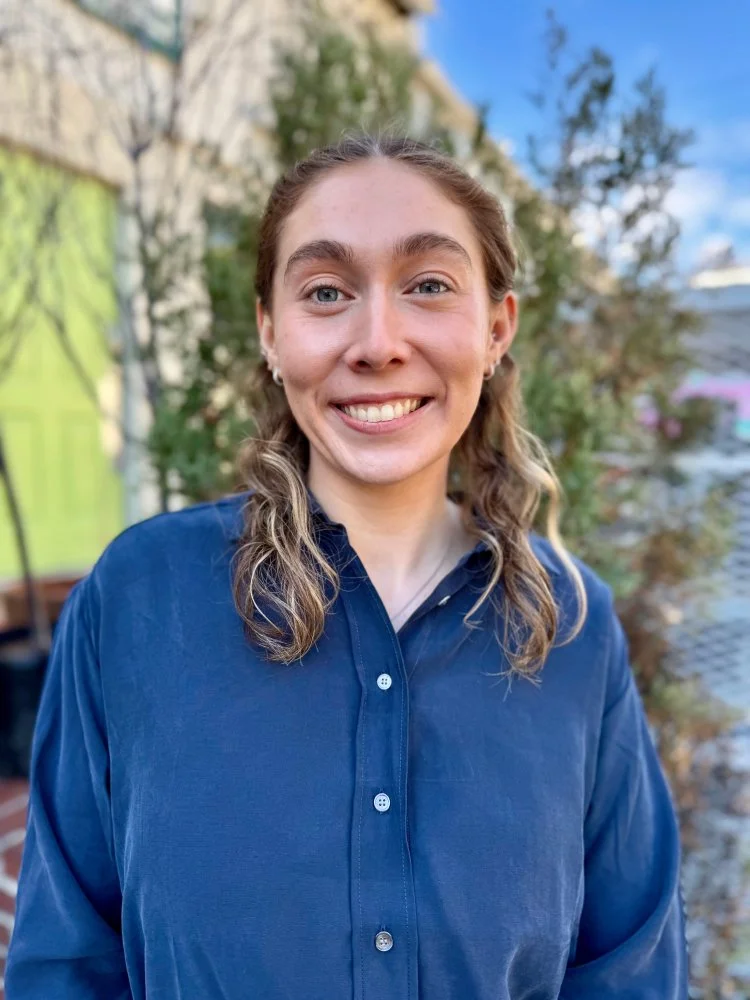
At The Center for Family Well-Being, we know growth happens best when people feel seen, heard, and supported. That’s exactly what our newest therapist, Bridget McGuinness, brings to her work with kids, teens, and young adults. She’s passionate about helping clients navigate life’s challenges with care, curiosity, and connection, and we’re thrilled to welcome her to the Center.
We asked Bridget to share a little about her work at the Center. Meet Bridget:
Can you tell us a bit about your professional path — from graduate training to joining The Center for Family Well‑Being?
I went to the University of Michigan, where I completed a year-long internship at a nonprofit counseling center providing therapy to individuals and families with limited access to healthcare. That experience really shaped my social work perspective, and I became more interested in trauma-focused care and one-on-one work.
When I decided to move back to DC, I knew I wanted to find a setting that allowed me to continue providing that kind of meaningful, individualized therapy. The Center’s philosophy really resonated with me — it’s not just traditional talk therapy, but incorporates holistic wellness and the mind-body connection as well. I think this is incredibly important and often missing, especially in today’s world.
What has been one of the most meaningful learning experiences in your work so far?
Really understanding the value of therapeutic relationships. Everyone comes in at a different level of readiness, and it's rewarding to create a space where people feel comfortable, heard, and emotionally safe enough to allow deeper work to unfold over time. I love being able to point out growth and small wins so clients can recognize their own strengths.
Are there particular areas of ongoing study or skill development you’re excited about right now?
I have a background in Dialectical Behavior Therapy (DBT) and would love to continue deepening that work, especially with middle- and high-school students, because it gives them practical tools for managing emotions and difficult situations. I’m also very interested in polyvagal theory and other mind-body approaches.
Longer term, I hope to pursue Eye Movement Desensitization and Reprocessing (EMDR) and Internal Family Systems training, as both are especially helpful for trauma work. With younger clients, I’m excited to continue incorporating play-based strategies, using play, art, games, and movement to help kids express themselves.
How would you describe your therapeutic style or philosophy?
I view therapy as a partnership — I want to meet clients where they are and work alongside them developmentally and emotionally. My approach is strengths-based and collaborative, with attention to the systems and relationships that support each individual.
You're seeing younger children and adolescents, ages 8 and up. What are some common challenges you see these age groups bringing to therapy — and how do you help them navigate those?
This age range involves a lot of developmental change and transition. School stress, social challenges, family changes, and academic pressure — especially in the DC area — can all contribute to anxiety and perfectionism.
Many kids also struggle to name their emotions beyond broad terms, so I help them break those feelings into more manageable pieces and learn how to name what they’re experiencing. From there, we work on learning developmentally appropriate coping tools — eventually they have a really helpful toolbox they can draw from in different situations.
What belief or value do you bring into every session — even on the tough days?
I believe clients are doing the best they can with the resources they have. Growth isn’t linear, and people are allowed to have hard weeks. That's why I'm here! I try to consistently show up with a strengths-based perspective, paying attention to the little wins — not to negate the difficult things that are going on, just to remind them that there is positivity even within darkness.